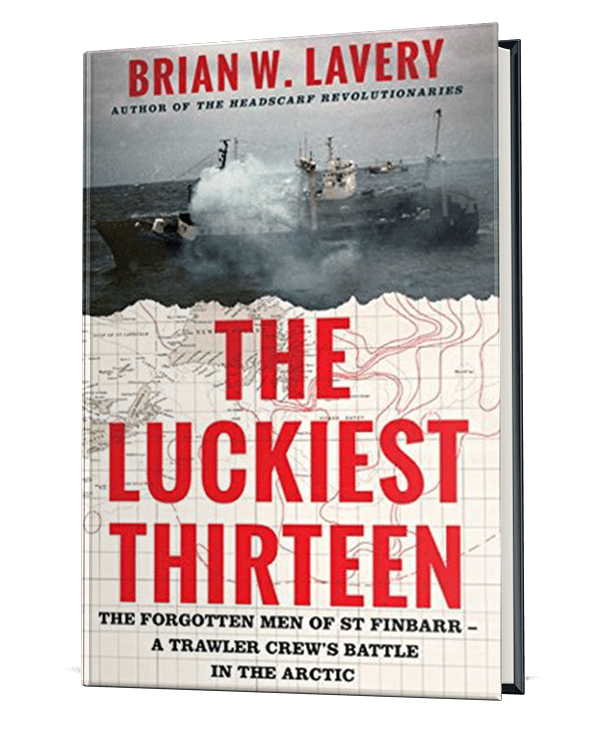



The honour of being my first book of 2023 goes to The Lucky Thirteen by Brian W Lavery. Now, this is already unusual territory for me because it’s non-fiction. I don’t avoid non-fiction out of principle, it’s just that I normally prefer to disappear into worlds with dragons, conspiracies, or at the very least a suspiciously clever professor. Real life, frankly, has a habit of being a bit too real.
But here’s the thing. Lavery has written this in such a way that it feels like fiction. Not in a “made-up” sense, but in that gripping, can’t-put-it-down, “just one more chapter” way that quietly robs you of sleep and leaves you blinking at the clock wondering what happened to your evening. Unfortunately, the events themselves are anything but fictional. What unfolds is a harrowing account of survival, loss, and the kind of courage most of us are quite happy never having to test.
At the heart of the book is the Hull trawler St Finbarr, which runs into catastrophic trouble off the coast of Newfoundland on Christmas Day, 1966. Not exactly the sort of festive drama anyone had in mind. This wasn’t some creaking relic either, it was one of the newer freezer trawlers, practically luxury compared to the older boats. Though “luxury” here is doing some heavy lifting, it still involved months at sea, brutal conditions, and a job description that casually included “might not come back.”
As the story unfolds, you’re drawn into the lives of the crew, these tough, matter-of-fact men who headed out into the North Atlantic as if it were just another day at the office, albeit an office that could freeze you solid and swallow you whole. Lavery takes the time to show who they were, not just what happened to them, and that’s what gives the story its weight.
If the name rings a bell, it might be because Lavery also wrote The Headscarf Revolutionaries, which tells the story of Lilian Bilocca and the triple trawler tragedy. While researching that, he uncovered this story and, thankfully, decided it needed telling too. He has a real talent for taking historical events and breathing life into them, not just presenting facts but building something vivid and immediate.
You feel the tension tightening as the situation worsens. Then the focus shifts back to Hull, where news trickles in on Christmas Day, slow, uncertain, and increasingly grim. At first, no one knows who has survived. Families cling to scraps of hope while the truth edges closer. It’s the kind of moment where the festive backdrop makes everything hit harder, Christmas dinner going cold while lives are quietly unravelling.
And then there are the people tasked with delivering the news, a job no one would volunteer for in a thousand years. The knock on the door. The pause before speaking. The moment everything changes. Lavery handles these scenes with a great deal of care, never overplaying them, which somehow makes them land even harder.
Along the way, you also get a glimpse into the wider world of the trawlermen, the so-called “three-day millionaires,” earning hard, spending fast, and living in a cycle that feels almost unreal now. It’s a snapshot of a different era, but one that wasn’t all that long ago, and that’s part of what makes it linger.
I finished the book with a deep respect for these men and the lives they led. It’s a powerful, compassionate telling of a disaster that feels both distant and uncomfortably close. Lavery doesn’t just recount events, he populates them with people you come to care about, which makes the outcome all the more affecting.
It’s probably far too early to declare a “book of the year,” but I’ll say this, anything that wants to take that crown is going to have to work very hard indeed.
In short, read it. Just maybe don’t expect a light, cheerful ride. This one stays with you.